From Wikipedia, the free encyclopedia
In astrophysics and cosmology, dark matter is a hypothetical form of matter that does not emit or reflect enough electromagnetic radiation to be observed directly, but whose presence can be inferred from gravitational effects on visible matter. According to present observations of structures larger than galaxies, as well as Big Bang cosmology, dark matter accounts for the vast majority of mass in the observable universe. The observed phenomena consistent with dark matter observations include the rotational speeds of galaxies, orbital velocities of galaxies in clusters, gravitational lensing of background objects by galaxy clusters such as the Bullet cluster, and the temperature distribution of hot gas in galaxies and clusters of galaxies. Dark matter also plays a central role in structure formation and galaxy evolution, and has measurable effects on the anisotropy of the cosmic microwave background. All these lines of evidence suggest that galaxies, clusters of galaxies, and the universe as a whole contain far more matter than that which interacts with electromagnetic radiation: the remainder is called the "dark matter component."
The composition of dark matter is unknown but may include ordinary and heavy neutrinos, recently postulated elementary particles such as WIMPs and axions, astronomical bodies such as dwarf stars and planets (collectively called MACHOs), primordial black holes and clouds of nonluminous gas. Also, matter that might exist in another universe but might affect ours via gravity would be consistent with some theories of brane cosmology. Current evidence favors models in which the primary component of dark matter is new elementary particles, collectively called nonbaryonic dark matter.
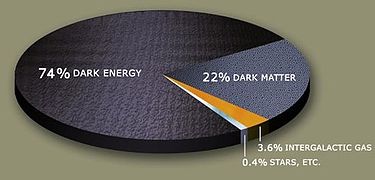
The dark matter component has vastly more mass than the "visible" component of the universe.[1] At present, the density of ordinary baryons and radiation in the universe is estimated to be equivalent to about one hydrogen atom per cubic meter of space. Only about 4% of the total energy density in the universe (as inferred from gravitational effects) can be seen directly. About 22% is thought to be composed of dark matter. The remaining 74% is thought to consist of dark energy, an even stranger component, distributed diffusely in space.[2] Some hard-to-detect baryonic matter makes a contribution to dark matter but constitutes only a small portion.[3][4] Determining the nature of this missing mass is one of the most important problems in modern cosmology and particle physics. It has been noted that the names "dark matter" and "dark energy" serve mainly as expressions of human ignorance, much as the marking of early maps with "terra incognita."[2]
[edit]
Observational evidence
The first to provide evidence and infer the existence of a phenomenon that has come to be called "dark matter" was Swiss astrophysicist Fritz Zwicky, of the California Institute of Technology (Caltech) in 1933.[5] He applied the virial theorem to the Coma
cluster of galaxies and obtained evidence of unseen mass. Zwicky estimated the cluster's total mass based on the motions of galaxies near its edge. When he compared this mass estimate to one based on the number of galaxies and total brightness of the cluster, he found that there was about 400 times more mass than expected. The gravity of the visible galaxies in the cluster would be far too small for such fast orbits, so something extra was required. This is known as the "missing mass problem". Based on these conclusions, Zwicky inferred that there must be some non-visible form of matter which would provide enough of the mass and gravity to hold the cluster together.
Much of the evidence for dark matter comes from the study of the motions of galaxies. Many of these appear to be fairly uniform, so by the virial theorem the total kinetic energy should be half the total gravitational binding energy of the galaxies. Experimentally, however, the total kinetic energy is found to be much greater: in particular, assuming the gravitational mass is due to only the visible matter of the galaxy, stars far from the center of galaxies have much higher velocities than predicted by the virial theorem. Galactic rotation curves, which illustrate the velocity of rotation versus the distance from the galactic center, cannot be explained by only the visible matter. Assuming that the visible material makes up only a small part of the cluster is the most straightforward way of accounting for this. Galaxies show signs of being composed largely of a roughly spherically symmetric, centrally concentrated halo of dark matter with the visible matter concentrated in a disc at the center. Low surface brightness dwarf galaxies are important sources of information for studying dark matter, as they have an uncommonly low ratio of visible matter to dark matter, and have few bright stars at the center which impair observations of the rotation curve of outlying stars.
Gravitational lensing can be used to directly map the total distribution of mass, including both dark matter and visible material[6]. In most regions of the universe, dark matter and visible material are found together[7], as expected because of their mutual gravitational attraction. However, the different forms of matter were separated by the violent collision of two clusters of galaxies about 150 million years ago, a system known as the Bullet Cluster[8][9]. Researchers mapped the distribution of mass using measurements of gravitational lensing, and compared it to X-ray maps showing hot gases, thought to constitute the large majority of ordinary matter in the clusters. The hot gases in the two clusters collided and slowed down: they now lie close to the point of impact. Conversely, the individual galaxies and the dark matter did not interact, so are now further apart. In several hundred more million years, gravitational attraction between the different concentrations of matter is expected to pull them back together, reproducing the usual configuration.
[edit]
Galactic rotation curves
For 40 years after Zwicky's initial observations, no other corroborating observations indicated that the mass to light ratio was anything other than unity (a high mass-to-light ratio indicates the presence of dark matter). Then, in the late 1960s and early 1970s, Vera Rubin, a young astronomer at the Department of Terrestrial Magnetism at the Carnegie Institution of Washington presented findings based on a new sensitive spectrograph that could measure the velocity curve of edge-on spiral galaxies to a greater degree of accuracy than had ever before been achieved. Together with fellow staff-member Kent Ford, Rubin announced at a 1975 meeting of the American Astronomical Society the astonishing discovery that most stars in spiral galaxies orbit at roughly the same speed, which implied that their mass densities were uniform well beyond the locations with most of the stars (the galactic bulge). This result suggests that either Newtonian gravity does not apply universally or that, conservatively, upwards of 50% of the mass of galaxies was contained in the relatively dark galactic halo. Met with skepticism, Rubin insisted that the observations were correct. Eventually other astronomers began to corroborate her work and it soon became well-established that most galaxies were in fact dominated by "dark matter"; exceptions appeared to be galaxies with mass-to-light ratios close to that of stars. Subsequent to this, numerous observations have been made that do indicate the presence of dark matter in various parts of the cosmos. Together with Rubin's findings for spiral galaxies and Zwicky's work on galaxy clusters, the observational evidence for dark matter has been collecting over the decades to the point that today most astrophysicists accept its existence. As a unifying concept, dark matter is one of the dominant features considered in the analysis of structures on the order of galactic scale and larger.
[edit]
Velocity dispersions of galaxies
Rubin's pioneering work has stood the test of time. Measurements of velocity curves in spiral galaxies were soon followed up with velocity dispersions of elliptical galaxies. While sometimes appearing with lower mass-to-light ratios, measurements of ellipticals still indicate a relatively high dark matter content. Likewise, measurements of the diffuse interstellar gas found at the edge of galaxies indicate not only dark matter distributions that extend beyond the visible limit of the galaxies, but also that the galaxies are virialized up to ten times their visible radii. This has the effect of pushing up the dark matter as a fraction of the total amount of gravitating matter from 50% measured by Rubin to the now accepted value of nearly 95%.
There are places where dark matter seems to be a small component or totally absent. Globular clusters show no evidence that they contain dark matter, though their orbital interactions with galaxies do show evidence for galactic dark matter. For some time, measurements of the velocity profile of stars seemed to indicate concentration of dark matter in the disk of the Milky Way galaxy, however, now it seems that the high concentration of baryonic matter in the disk of the galaxy (especially in the interstellar medium) can account for this motion. Galaxy mass profiles are thought to look very different from the light profiles. The typical model for dark matter galaxies is a smooth, spherical distribution in virialized halos. Such would have to be the case to avoid small-scale (stellar) dynamical effects. Recent research reported in January 2006 from the University of Massachusetts, Amherst would explain the previously mysterious warp in the disk of the Milky Way by the interaction of the Large and Small Magellanic Clouds and the predicted 20 fold increase in mass of the Milky Way taking into account dark matter.
In 2005, astronomers from Cardiff University claimed to discover a galaxy made almost entirely of dark matter, 50 million light years away in the Virgo Cluster, which was named VIRGOHI21.[10] Unusually, VIRGOHI21 does not appear to contain any visible stars: it was seen with radio frequency observations of hydrogen. Based on rotation profiles, the scientists estimate that this object contains approximately 1000 times more dark matter than hydrogen and has a total mass of about 1/10th that of the Milky Way Galaxy we live in. For comparison, the Milky Way is believed to have roughly 10 times as much dark matter as ordinary matter. Models of the Big Bang and structure formation have suggested that such dark galaxies should be very common in the universe, but none had previously been detected. If the existence of this dark galaxy is confirmed, it provides strong evidence for the theory of galaxy formation and poses problems for alternative explanations of dark matter.
Recently too there is evidence that there are 10 to 100 times fewer small galaxies than permitted by what the dark matter theory of galaxy formation predicts. There are also a small number of galaxies, like NGC 3379 whose measured orbital velocity of its gas clouds, show that it contains almost no dark matter at all[11].
[edit]
Missing matter in clusters of galaxies
Dark matter affects galaxy clusters as well. X-ray measurements of hot intracluster gas correspond closely to Zwicky's observations of mass-to-light ratios for large clusters of nearly 10 to 1. Many of the experiments of the Chandra X-ray Observatory use this technique to independently determine the mass of clusters.
The galaxy cluster Abell 2029 is composed of thousands of galaxies enveloped in a cloud of hot gas, and an amount of dark matter equivalent to more than 1014 Suns. At the center of this cluster is an enormous, elliptically shaped galaxy that is thought to have been formed from the mergers of many smaller galaxies.[12] The measured orbital velocities of galaxies within galactic clusters have been found to be consistent with dark matter observations.
Another important tool for future dark matter observations is gravitational lensing. Lensing relies on the effects of general relativity to predict masses without relying on dynamics, and so is a completely independent means of measuring the dark matter. Strong lensing, the observed distortion of background galaxies into arcs when the light passes through a gravitational lens, has been observed around a few distant clusters including Abell 1689 (pictured right). By measuring the distortion geometry, the mass of the cluster causing the phenomena can be obtained. In the dozens of cases where this has been done, the mass-to-light ratios obtained correspond to the dynamical dark matter measurements of clusters.
Perhaps more convincing, a technique has been developed over the last 10 years called gravitational weak lensing, which looks at minute distortions of galaxies observed in vast galaxy surveys due to foreground objects through statistical analyses. By examining the shear deformation of the adjacent background galaxies, astrophysicists can characterize the mean distribution of dark matter by statistical means and have found mass-to-light ratios that correspond to dark matter densities predicted by other large-scale structure measurements. The correspondence of the two gravitational lens techniques to other dark matter measurements has convinced almost all astrophysicists that dark matter actually exists as a major component of the universe's composition.
[edit]
Structure formation
Dark matter is crucial to the Big Bang model of cosmology as a component which corresponds directly to measurements of the parameters associated with Friedmann cosmology solutions to general relativity. In particular, measurements of the cosmic microwave background anisotropies correspond to a cosmology where much of the matter interacts with photons more weakly than the known forces that couple light interactions to baryonic matter. Likewise, a significant amount of non-baryonic, cold matter is necessary to explain the large-scale structure of the universe.
Observations suggest that structure formation in the universe proceeds hierarchically, with the smallest structures collapsing first and followed by galaxies and then clusters of galaxies. As the structures collapse in the evolving universe, they begin to "light up" as the baryonic matter heats up through gravitational contraction and the object approaches hydrostatic pressure balance. Ordinary baryonic matter had too high a temperature, and too much pressure left over from the Big Bang to collapse and form smaller structures, such as stars, via the Jeans instability. Dark matter acts as a compactor of structure. This model not only corresponds with statistical surveying of the visible structure in the universe but also corresponds precisely to the dark matter predictions of the cosmic microwave background.
This bottom up model of structure formation requires something like cold dark matter to succeed. Large computer simulations of billions of dark matter particles have been used to confirm that the cold dark matter model of structure formation is consistent with the structures observed in the universe through galaxy surveys, such as the Sloan Digital Sky Survey and 2dF Galaxy Redshift Survey, as well as observations of the Lyman-alpha forest. These studies have been crucial in constructing the Lambda-CDM model which measures the cosmological parameters, including the fraction of the universe made up of baryons and dark matter.
[edit]
Dark matter composition
uestion_mark2.svg">
XImageTransform.Microsoft.AlphaImageLoader(src='http://upload.wikimedia.org/wikipedia/commons/thumb/b/b0/Question_mark2.svg/40px-Question_mark2.svg.png'); WIDTH: 1px; HEIGHT: 1px;">Although dark matter was detected by its gravitational lensing in August 2006,[13] many aspects of dark matter remain speculative. The DAMA/NaI experiment and its successor DAMA/LIBRA have claimed to directly detect dark matter passing through the Earth, though most scientists remain skeptical since negative results of other experiments are (almost) incompatible with the DAMA results if dark matter consists of neutralinos.
Data from a number of lines of evidence, including galaxy rotation curves, gravitational lensing, structure formation, and the fraction of baryons in clusters and the cluster abundance combined with independent evidence for the baryon density, indicate that 85-90% of the mass in the universe does not interact with the electromagnetic force. This "dark matter" is evident through its gravitational effect. Several categories of dark matter have been postulated.
Davis et al wrote in 1985:
Candidate particles can be grouped into three categories on the basis of their effect on the fluctuation spectrum (Bond et al 1983). If the dark matter is composed of abundant light particles which remain relativistic until shortly before recombination, then it may be termed "hot". The best candidate for hot dark matter is a neutrino [..] A second possibility is for the dark matter particles to interact more weakly than neutrinos, to be less abundant, and to have a mass of order 1eV. Such particles are termed "warm dark matter", because they have lower thermal velocities than massive neutrinos [..] there are at present few candidate particles which fit this description. Gravitinos and photinos have been suggested (Pagels and Primack 1982; Bond, Szalay and Turner 1982) [..] Any particles which became nonrelativistic very early, and so were able to diffuse a negligible distance, are termed "cold" dark matter (CDM). There are many candidates for CDM including supersymmetric particles[18]
Hot dark matter consists of particles that travel with relativistic velocities. One kind of hot dark matter is known, the neutrino. Neutrinos have a very small mass, do not interact via either the electromagnetic or the strong nuclear force and are therefore very difficult to detect. This is what makes them appealing as dark matter. However, bounds on neutrinos indicate that ordinary neutrinos make only a small contribution to the density of dark matter.
Hot dark matter cannot explain how individual galaxies formed from the Big Bang. The microwave background radiation as measured by the COBE and WMAP satellites, while incredibly smooth, indicates that matter has clumped on very small scales. Fast moving particles, however, cannot clump together on such small scales and, in fact, suppress the clumping of other matter. Hot dark matter, while it certainly exists in our universe in the form of neutrinos, is therefore only part of the story.
arkMatterPie.jpg">
arkMatterPie.jpg">
XImageTransform.Microsoft.AlphaImageLoader(src='http://en.wikipedia.org/skins-1.5/common/images/magnify-clip.png'); WIDTH: 1px; HEIGHT: 1px;">Estimated distribution of dark matter and dark energy in the universe
The Concordance Model requires that, to explain structure in the universe, it is necessary to invoke cold (non-relativistic) dark matter. Large masses, like galaxy-sized black holes can be ruled out on the basis of gravitational lensing data. Possibilities involving normal baryonic matter include brown dwarfs or perhaps small, dense chunks of heavy elements; such objects are known as massive compact halo objects, or "MACHOs". However, studies of big bang nucleosynthesis have convinced most scientists that baryonic matter such as MACHOs cannot be more than a small fraction of the total dark matter.
At present, the most common view is that dark matter is primarily non-baryonic, made of one or more elementary particles other than the usual electrons, protons, neutrons, and known neutrinos. The most commonly proposed particles are axions, sterile neutrinos, and WIMPs (Weakly Interacting Massive Particles, including neutralinos). None of these are part of the standard model of particle physics, but they can arise in extensions to the standard model. Many supersymmetric models naturally give rise to stable WIMPs in the form of neutralinos. Heavy, sterile neutrinos exist in extensions to the standard model that explain the small neutrino mass through the seesaw mechanism.
[edit]
Detection of dark matter
These cosmological models predict that if WIMPs are what make up dark matter, trillions must pass through the Earth each second. Despite a number of attempts to find these WIMPs, none have yet been confirmedly found.
Experimental searches for these dark matter candidates have been conducted and are ongoing. These efforts can be divided into two broad classes: direct detection, in which the dark matter particles are observed in a detector; and indirect detection, which looks for the products of dark matter annihilations. Dark matter detection experiments have ruled out some WIMP and axion models. There are also several experiments claiming positive evidence for dark matter detection, such as DAMA/NaI, DAMA/LIBRA[19] and EGRET, but these are so far unconfirmed and difficult to reconcile with the negative results of other experiments. Several searches for dark matter are currently underway, including the Cryogenic Dark Matter Search in the Soudan mine, the XENON, DAMA/LIBRA and CRESST experiments at Gran Sasso and the ZEPLIN project at the Boulby Underground Laboratory (UK), and many new technologies are under development, such as the ArDM experiment.
One possible alternative approach to the detection of WIMPs in nature is to produce them in the laboratory. Experiments with the Large Hadron Collider near Geneva may be able to detect WIMPs. Because a WIMP only has negligible interactions with matter, it can be detected as missing energy and momentum. It is also possible that dark matter consists of very heavy hidden sector particles which only interact with ordinary matter via gravity.
The Cryogenic Dark Matter Search, in the Soudan Mine in Minnesota aims to detect the heat generated when ultracold germanium and silicon
crystals are struck by a WIMP. The Gran Sasso National Laboratory at L'Aquila, in Italy, use xenon to measure the flash of light that occurs on those rare occasions when a WIMP strikes a xenon nucleus. The results from April 2007, using 15 kg of liquid and gaseous xenon, failed to detect any, and in March 2008 the team started again using 150 kg of the material.
The GLAST space telescope, planned for launch in October 2008, searching gammawave events, may also detect WIMPs. WIMP supersymmetric particle and antiparticle collisions should release a pair of detectable gamma waves. The number of events detected will show to what extent WIMPs comprise dark matter.
With all these experiments together, scientists are becoming confident that WIMPs will be discovered in the near future. But some scientists are beginning to think that dark matter is composed of many different candidates [20]. WIMPs may thus only be a part of the solution.
[edit]
Alternative explanations
[edit]
Modifications of gravity
A proposed alternative to physical dark matter particles has been to suppose that the observed inconsistencies are due to an incomplete understanding of gravitation. To explain the observations, the gravitational force has to become stronger than the Newtonian approximation at great distances or in weak fields. One of the proposed models is Modified Newtonian Dynamics (MOND), which corrects Newton's laws at small acceleration. However, constructing a relativistic MOND theory has been troublesome, and it is not clear how the theory can be reconciled with gravitational lensing measurements of the deflection of light around galaxies. The leading relativistic MOND theory, proposed by Jacob Bekenstein in 2004 is called TeVeS for Tensor-Vector-Scalar and solves many of the problems of earlier attempts. However, a study in August 2006 reported an observation of a pair of colliding galaxy clusters whose behavior, it was claimed, was not compatible with any current modified gravity theories[21].
In 2007, astronomer John W. Moffatt proposed a theory of modified gravity (MOG) based on the Nonsymmetric Gravitational Theory (NGT) that accounts for the behavior of colliding galaxies.[22]
[edit]
Quantum mechanical explanations
In another class of theories one attempts to reconcile gravitation with quantum mechanics and obtains corrections to the conventional gravitational interaction. In scalar-tensor theories, scalar fields like the Higgs field couple to the curvature given through the Riemann tensor or its traces. In many of such theories, the scalar field equals the inflaton field, which is needed to explain the inflation of the universe after the Big Bang, as the dominating factor of the quintessence or Dark Energy. Using an approach based on the exact renormalization group, M. Reuter and H. Weyer have shown[23] that Newton's constant and the cosmological constant can be scalar functions on spacetime if one associates renormalization scales to the points of spacetime. Some M-Theory cosmologists also propose that multi-dimensional forces from outside the visible universe have gravitational effects on the visible universe meaning that dark matter is not necessary for a unified theory of cosmology.
However it is important to remember that if dark matter passes through matter freely, a detector created from matter has little or no chance of either proving or disproving the existence of dark matter or energy.
[edit]
Dark matter in popular culture
Mentions of dark matter occur in some video games and other works of fiction. In such cases, it is usually attributed extraordinary physical or magical properties. Such descriptions are often inconsistent with the properties of dark matter proposed in physics and cosmology.



 京公网安备11010202008513号 京ICP证101109号 京ICP备12012021号


 发表于 2008-6-2 00:37:00
 uestions">Find out how to ask questions and get answers. •



 楼主
楼主


 hysical_cosmology">


